
Ever wondered how long until 6 AM while lying awake at night? You are not alone. Many people check the clock and try to count the hours left before morning. The answer depends on the time it is right now.
The good news is that the math is simple. You only need to subtract the current time from 6:00 AM. If it is already past 6 AM, count the hours to midnight and add 6 more. This guide shows you how to do it fast.
Below, you will find an easy time chart, a quick formula, and real examples. You will also learn how to plan your sleep so you wake up feeling better. Let’s get started.
Quick Answer: How Many Hours Until 6 AM?
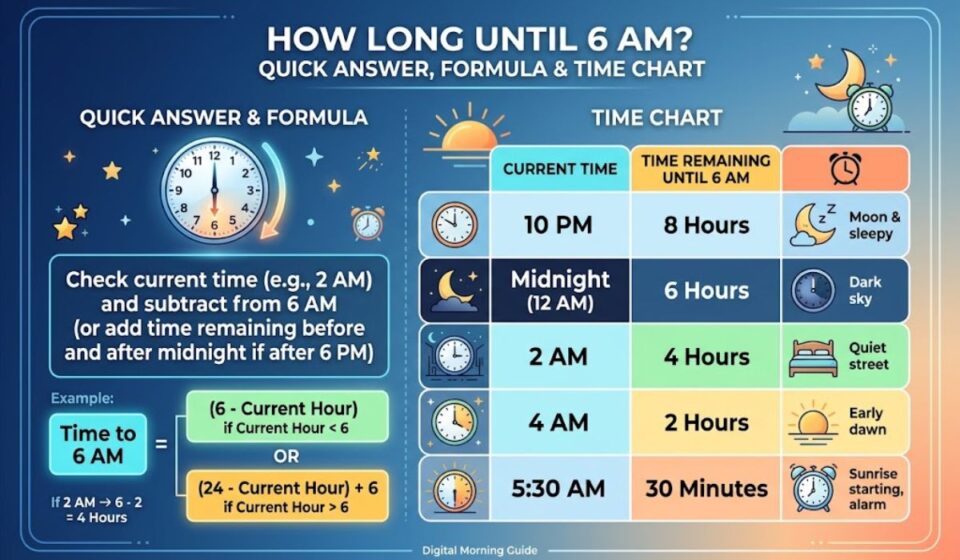
To find how long until 6 AM, subtract the current time from 6:00 AM. If it is already past 6 AM, subtract the current time from 30 (on a 24-hour clock). At 11 PM, it is 7 hours. At 2 AM, it is 4 hours. At 5:30 AM, it is 30 minutes.
That block covers most searches. The rest of this article shows how to do the math fast and what to do with the time you have.
At-a-Glance Chart: Time Left Until 6 AM
Find your current time in the left column. The right column shows how long you must wait for the next 6:00 AM.
| Current Time | Time Until 6 AM |
| 12:00 PM (noon) | 18 hours |
| 6:00 PM | 12 hours |
| 8:00 PM | 10 hours |
| 9:00 PM | 9 hours |
| 10:00 PM | 8 hours |
| 11:00 PM | 7 hours |
| 12:00 AM (midnight) | 6 hours |
| 1:00 AM | 5 hours |
| 2:00 AM | 4 hours |
| 3:00 AM | 3 hours |
| 4:00 AM | 2 hours |
| 5:00 AM | 1 hour |
| 5:30 AM | 30 minutes |
For times between the hours, adjust by the minutes. At 10:45 PM, you have 7 hours and 15 minutes.
How to Calculate Time Until 6 AM
You can do this in your head once you know the two cases. Pick the one that matches your situation.
Case 1: It Is Before 6 AM
This is the easy one. Both times are on the same morning.
Formula: 6:00 − current time
- Current time 3:20 AM → 6:00 − 3:20 = 2 hours 40 minutes
- Current time 4:50 AM → 6:00 − 4:50 = 1 hour 10 minutes
If the minutes don’t subtract cleanly, borrow an hour. Think of 6:00 as 5:60.
Case 2: It Is After 6 AM
Now you are counting to tomorrow morning. First find the time left until midnight, then add 6 hours.
Formula: (12:00 − current time) + 6 hours
- Current time 9:30 PM → 2h 30m to midnight + 6h = 8 hours 30 minutes
- Current time 11:10 PM → 50m to midnight + 6h = 6 hours 50 minutes
The 24-Hour Shortcut
If you use a 24-hour clock, there is an even faster trick. After 6 AM, subtract your time from 30.
At 22:00, that is 30 − 22 = 8 hours. At 19:30, it is 30 − 19.5 = 10 hours 30 minutes. This works because 6 AM tomorrow is “hour 30” counting from today’s midnight.
Hours, Minutes, and Seconds Until 6 AM
Sometimes you need the exact figure for a timer, an alarm, or a shift schedule. This table converts common gaps.
| Hours Left | Minutes | Seconds |
| 1 hour | 60 | 3,600 |
| 2 hours | 120 | 7,200 |
| 3 hours | 180 | 10,800 |
| 4 hours | 240 | 14,400 |
| 5 hours | 300 | 18,000 |
| 6 hours | 360 | 21,600 |
| 8 hours | 480 | 28,800 |
| 10 hours | 600 | 36,000 |
For a live countdown that ticks second by second, a timer app or a browser countdown page will do it better than mental math. The formula is for when you want the answer without opening anything.
What Fits Before 6 AM? Sleep Planning
Most people ask this question at night, and the real worry is sleep. Will you get enough before the alarm?
Adults generally need 7 or more hours of sleep. Sleep runs in cycles of roughly 90 minutes, and the length varies a bit from person to person. Waking at the end of a cycle usually feels easier than waking in the middle of deep sleep.
Most healthy adults also take around 10 to 20 minutes to fall asleep. Add that buffer when you count back from your alarm.
Bedtime Chart for a 6:00 AM Wake-Up
| Sleep Cycles | Total Sleep | Fall Asleep By | Lights Out (with 15 min buffer) |
| 6 cycles | 9 hours | 9:00 PM | 8:45 PM |
| 5 cycles | 7.5 hours | 10:30 PM | 10:15 PM |
| 4 cycles | 6 hours | 12:00 AM | 11:45 PM |
| 3 cycles | 4.5 hours | 1:30 AM | 1:15 AM |
Five cycles is the sweet spot for most adults. If it is already past midnight and you have only 4.5 hours left, a short night is better than none. Skip the screen, dim the lights, and fall asleep as fast as you can.
Real-Life Example
It is 11:20 PM. You must wake at 6 AM.
- Time left: 6 hours 40 minutes
- Minus 15 minutes to fall asleep: about 6 hours 25 minutes of sleep
- That is four full cycles plus a little extra
If you can be asleep by 11:30 PM instead of lingering on your phone, you protect every one of those minutes. Waking at 6:00 on four cycles is far better than lying awake doing math until 2 AM.
Time Zones and Daylight Saving: Why “6 AM” Isn’t the Same Everywhere
Your countdown targets local time. That sounds obvious until you coordinate with someone in another country, or until the clocks change.
Time Zone Comparison
Here is what time it is in other cities when it is 6:00 AM in New York (Eastern Standard Time, UTC−5). Offsets shift when a region moves between standard time and daylight saving time, so check your own region’s current rules.
| City | Approx. Local Time |
| Los Angeles | 3:00 AM |
| London | 11:00 AM |
| Dubai | 3:00 PM |
| Islamabad / Karachi | 4:00 PM |
| Tokyo | 8:00 PM |
Use this when you plan calls, flights, or shift handovers across borders. Always convert both sides to one reference, like UTC, before you subtract.
The Daylight Saving Trap
When clocks move back one hour, the night is one hour longer. When they move forward, it is one hour shorter. So at 10 PM on a clock-change night, the gap to 6 AM might be 9 hours or 7 hours, not the usual 8.
Your phone updates itself, but a wall clock or a basic alarm might not. If a change is coming this weekend, check before you trust your mental math.
Related Terms and Concepts
These terms often show up next to this search. Knowing them helps when you read schedules or set timers.
| Term | What It Means |
| 6 AM | Six in the morning, from the Latin ante meridiem (“before midday”) |
| 06:00 / 0600 | The same moment in 24-hour or military notation |
| Countdown timer | A tool that shows the live time remaining to a set moment |
| Time difference | The gap between two clock times, in hours and minutes |
| Sleep latency | How long it takes you to fall asleep |
| Sleep cycle | A roughly 90-minute loop through light, deep, and REM sleep |
| Dawn vs. sunrise | Dawn is the first light; sunrise is when the sun’s edge appears |
| UTC offset | How far a time zone sits from Coordinated Universal Time |
One detail worth knowing: 6 AM is not the same as sunrise. In many places the sun rises well after 6 AM in winter and earlier in summer. If you are waiting for daylight rather than a clock time, look up your local sunrise.
Common Mistakes When Counting Down to 6 AM
Small slips cause most errors here. Avoid these and your math will hold.
Do’s and Don’ts
| ✅ Do | ❌ Don’t |
| Convert to 24-hour time if the 12-hour clock confuses you | Mix AM and PM in the same subtraction |
| Add your fall-asleep buffer to the countdown | Count every minute as sleep time |
| Check for daylight saving changes | Assume the night is always the same length |
| Set an alarm with a backup | Trust one alarm when you have a hard deadline |
| Count to your real deadline (leave time to get ready) | Plan around 6:00 sharp if you need to leave by then |
Mistakes Worth a Closer Look
- Forgetting midnight resets the clock. From 11 PM, many people say “6 hours” because 11 to 5 is 6. The right answer is 7. Count to midnight first, then add 6.
- Ignoring the real hard stop. If a truck, a train, or a shift starts at 6, your true deadline is earlier. Count back from when you must be up and moving, not when the event starts.
- Checking the time repeatedly in bed. Looking at the clock raises stress and makes it harder to sleep. Set the alarm, turn the screen away, and stop calculating.
- Doing math while exhausted. Tired brains make simple subtraction errors. Use the chart above instead.
Practical Tips for the Hours Before 6 AM
Your plan changes with how much time you have. Use this as a rough guide.
| Time Left | Best Move |
| 8+ hours | Wind down, eat lightly, and go to bed on time |
| 6–8 hours | Go to bed within the hour for a full night |
| 4–6 hours | Sleep now. Aim for complete cycles |
| 2–3 hours | Take a short sleep if you can, or stay up and keep lights bright |
| Under 1 hour | Don’t start a nap. Get up slowly and drink water |
If you are working a night shift or finishing a deadline, plan your breaks around the gap too. A 20-minute nap helps. A long, uneven nap right before 6 AM usually leaves you groggy.
Frequently Asked Questions
How many hours until 6 AM if it is 12 AM?
It is exactly 6 hours from midnight to 6:00 AM.
How long until 6 AM if it is 10 PM?
You have 8 hours. That is 2 hours to midnight plus 6 more.
How many minutes until 6 AM from 5:15 AM?
There are 45 minutes left.
Is 6 AM a good wake-up time?
It works well for many people, especially if you go to bed early enough to get 7 or more hours. The best wake-up time is the one that fits your body and your schedule.
How do I set a countdown to 6 AM?
Use the timer or clock app on your phone, or a browser countdown page. Enter the target time as 6:00 AM, and it will tick down to the next occurrence.
Does the answer change if I am in a different time zone?
Yes. The countdown depends on your local time. Convert to one time zone before you calculate if you are working across regions.
Conclusion
Working out how long until 6 AM takes one step. If it is before 6, subtract the current time from 6:00. If it is after 6, count to midnight and add 6 hours. Keep the chart handy for a fast answer.
Then use the time well. If it is night, count your sleep in 90-minute cycles, leave a few minutes to fall asleep, and set your alarm. Check the clock once, then put the phone down. The sooner you stop counting, the sooner 6 AM arrives.