
You glance at the clock and wonder: how long until 10:25? Maybe it’s a meeting, a bus, a class bell, or a medication reminder.
A static page can’t read your clock, but it can give you the fastest way to work it out. You’ll get a lookup chart, a simple formula, and worked examples for AM, PM and overnight cases.
The Quick Answer
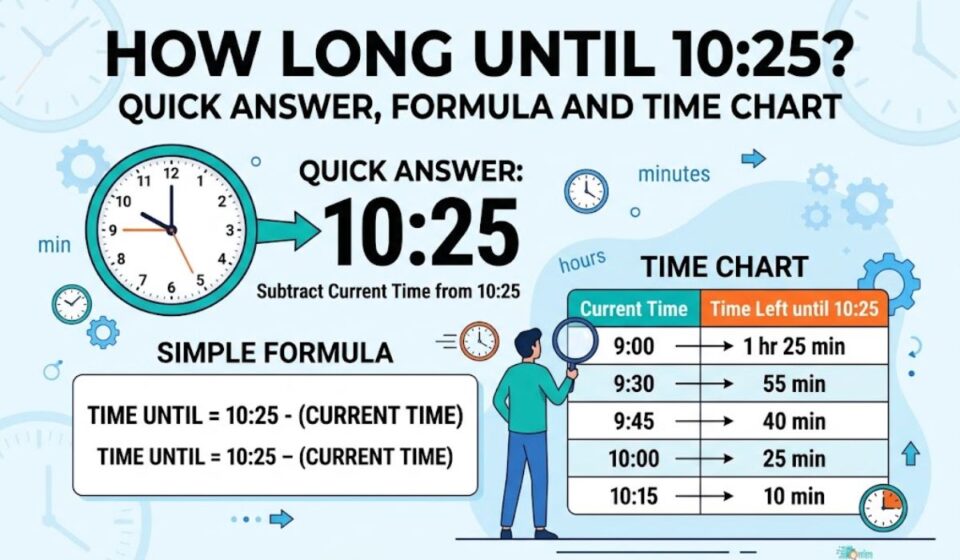
The time left until 10:25 depends on your clock right now. Subtract the current time from 10:25 using the 24-hour format. At 9:30 AM, you have 55 minutes. At 8:00 AM, you have 2 hours and 25 minutes. If 10:25 has already passed, count toward 10:25 tomorrow.
For a live, ticking countdown, set a timer on your phone or use a countdown website. The sections below show you how to do the math yourself.
What’s Covered
| Section | What You’ll Learn |
| Quick reference charts | Instant answers from common start times |
| The formula | A 3-step method that always works |
| Worked examples | Real scenarios, including overnight |
| AM vs PM | How to avoid the most common slip-up |
| Time zones | What 10:25 means elsewhere |
| Mistakes and tips | Do’s and don’ts |
| FAQs | Short answers to related searches |
Quick Reference: Time Left Until 10:25 AM
Find the time closest to your current time. The chart assumes you are counting toward the next 10:25 AM.
| Current Time | Time Left Until 10:25 AM | Total Minutes |
| 12:00 AM (midnight) | 10 hr 25 min | 625 |
| 3:00 AM | 7 hr 25 min | 445 |
| 6:00 AM | 4 hr 25 min | 265 |
| 8:00 AM | 2 hr 25 min | 145 |
| 9:00 AM | 1 hr 25 min | 85 |
| 9:30 AM | 55 min | 55 |
| 10:00 AM | 25 min | 25 |
| 10:15 AM | 10 min | 10 |
| 10:20 AM | 5 min | 5 |
Quick Reference: Time Left Until 10:25 PM
Evening plans work the same way. Here are the common checkpoints.
| Current Time | Time Left Until 10:25 PM | Total Minutes |
| 12:00 PM (noon) | 10 hr 25 min | 625 |
| 3:00 PM | 7 hr 25 min | 445 |
| 6:00 PM | 4 hr 25 min | 265 |
| 8:00 PM | 2 hr 25 min | 145 |
| 9:30 PM | 55 min | 55 |
| 10:00 PM | 25 min | 25 |
Notice the pattern. The gaps are identical in the AM and PM charts because both targets sit the same distance from their reference points.
10:25 in Different Formats
Many people search this question because they’re reading a schedule in a format they don’t use daily. Here is how 10:25 is written in each system.
| Term | 10:25 AM | 10:25 PM |
| 12-hour clock | 10:25 AM | 10:25 PM |
| 24-hour clock | 10:25 | 22:25 |
| Military time | 1025 hours | 2225 hours |
| Minutes after midnight | 625 | 1,345 |
| Spoken form | “ten twenty-five” | “ten twenty-five at night” |
| Common phrase | Twenty-five past ten | Twenty-five past ten |
Knowing the minutes after midnight figure is the secret to quick math. We’ll use it next.
How to Calculate the Time Until 10:25
You don’t need an app. You need one subtraction and one habit: always work in 24-hour time.
Step 1: Convert Your Current Time to 24-Hour Format
- Times from 1:00 AM to 12:59 PM stay the same. (12:00 AM becomes 00:00.)
- For afternoon and evening times, add 12 to the hour. So 4:47 PM becomes 16:47.
Step 2: Pick Your Target
- Heading for the morning 10:25? Use 10:25.
- Heading for the evening 10:25? Use 22:25.
Step 3: Subtract
Subtract the current time from the target. If the minutes part goes negative, borrow 60 minutes from the hours.
Here is a compact version of the whole method:
| Step | Action | Example (now = 7:48 AM) |
| 1 | Convert now to 24-hour | 07:48 |
| 2 | Choose target | 10:25 |
| 3 | Subtract hours | 10 − 7 = 3 hours |
| 4 | Subtract minutes | 25 − 48 = −23, so borrow 60 |
| 5 | Adjust | 2 hours and 37 minutes |
Result: 2 hours 37 minutes until 10:25 AM.
The Minutes-From-Midnight Shortcut
Some people find this faster. Convert both times to total minutes, then subtract once.
Example: It’s 4:47 PM and you want 10:25 PM.
- 4:47 PM = 16:47 = (16 × 60) + 47 = 1,007 minutes
- 10:25 PM = 22:25 = 1,345 minutes
- 1,345 − 1,007 = 338 minutes, or 5 hours 38 minutes
Divide 338 by 60 to check: 5 full hours (300 minutes) plus 38 left over. It works every time.
Worked Examples
Real situations are easier to remember than formulas. These four cover most cases.
| Scenario | Now | Target | Time Left |
| Morning commute | 8:40 AM | 10:25 AM | 1 hr 45 min |
| Lunch-hour planning | 12:10 PM | 10:25 PM | 10 hr 15 min |
| Late-night check | 11:50 PM | 10:25 AM | 10 hr 35 min |
| Target already passed | 11:15 AM | 10:25 AM (next day) | 23 hr 10 min |
When 10:25 Has Already Passed Today
This is the case that trips people up. Say it’s 11:15 AM and you ask about 10:25 AM. That moment is gone for today.
Add 24 hours to the target (or 1,440 minutes). Then subtract as usual.
- 625 + 1,440 = 2,065 minutes
- 11:15 AM = 675 minutes
- 2,065 − 675 = 1,390 minutes = 23 hours 10 minutes
A quick sanity check: the next 10:25 AM is almost a full day away, minus the 50 minutes since 10:25 passed. That matches.
Counting Across Midnight
At 11:50 PM, you’re 10 minutes from midnight and then 10 hours 25 minutes from 10:25 AM. Add them: 10 hours 35 minutes.
When you cross midnight, split the trip into two parts. Time until 12:00 AM, plus 625 minutes.
AM vs PM: The Easiest Way to Get It Wrong
Most wrong answers come from mixing up the two. Ask yourself one question: which 10:25 do I mean?
| Clue | Likely Means |
| Class, school, coffee, early meeting | 10:25 AM |
| Dinner, movie, bedtime, last train | 10:25 PM |
| Your phone shows 22:25 | 10:25 PM |
| Event listing says “mid-morning” | 10:25 AM |
If you’re unsure, calculate both. One of them will be much closer, and that’s usually your answer.
What Time Is 10:25 Somewhere Else?
Time zones add another layer. If you’re coordinating a call, convert the target before you subtract. The table below shows what 10:25 AM UTC looks like in standard time. Daylight saving changes some of these, so double-check before an important meeting.
| Location | Offset From UTC | Local Time at 10:25 UTC |
| London (GMT) | UTC+0 | 10:25 AM |
| Dubai | UTC+4 | 2:25 PM |
| India | UTC+5:30 | 3:55 PM |
| Singapore | UTC+8 | 6:25 PM |
| New York (EST) | UTC−5 | 5:25 AM |
| Los Angeles (PST) | UTC−8 | 2:25 AM |
Always do the time zone conversion first. Then run the subtraction in your own local time.
Common Mistakes and How to Avoid Them
Small slips cause big scheduling errors. Here are the most frequent ones.
Do’s and Don’ts
| ✅ Do | ❌ Don’t |
| Convert to 24-hour time before subtracting | Subtract 12-hour times without checking AM/PM |
| Borrow 60 minutes when minutes go negative | Treat minutes as if there were 100 per hour |
| Add 24 hours if the target has passed | Report a negative number of hours |
| Confirm the time zone for shared events | Assume everyone shares your clock |
| Leave a 5-10 minute buffer | Plan to arrive at exactly 10:25 |
The most common error is decimal thinking. People see 10:25 minus 9:50 and write 0.75. The real answer is 35 minutes, because an hour has 60 minutes, not 100.
Practical Tips for Beating the Clock
Knowing the time left is only useful if you act on it. These habits help.
- Set two alarms. One at the target time, one at 15 minutes before.
- Use “time until” widgets. Most phones let you pin a countdown to your home screen.
- Work backward. If 10:25 is a deadline, list tasks by how long each takes, then subtract.
- Chunk the time. A 1 hour 45 minute window fits three 30-minute blocks plus a 15-minute buffer.
- Say it aloud. Telling yourself “I have 40 minutes” feels more concrete than glancing at the clock.
Frequently Asked Questions
How long until 10:25 right now?
It depends on your current time. Subtract your clock time from 10:25 (or 22:25 for the evening). For a ticking answer in seconds, use a live countdown timer.
Is 10:25 AM or PM closer?
Whichever one is next on your clock. Look at the current time and choose the target that is still ahead of you.
How many hours until 10:25 tomorrow?
Add 24 hours to the target, then subtract your current time. At noon today, 10:25 AM tomorrow is 22 hours 25 minutes away.
How do I count down to 10:25 on my phone?
Open your clock app, choose Timer, and enter the hours and minutes you calculated. Or ask your voice assistant to set an alarm for 10:25.
Does daylight saving change the answer?
Yes, if the countdown crosses the clock change night. That night has 23 or 25 hours, so a calendar app handles it better than mental math.
Conclusion
Working out how long until 10:25 comes down to three moves. Use 24-hour time, subtract carefully, and add a day if the target has passed.
Keep the two reference charts handy for fast checks. Use the minutes-from-midnight shortcut when the numbers get messy. And when time zones or daylight saving enter the picture, convert first, then count.