
You are looking at the clock and wondering how many hours till 6 AM. Maybe your alarm is set. Maybe you are working a late shift. Or maybe you just can’t sleep and want to know how long is left.
This guide gives you the answer fast. You will learn the simple math, how to handle minutes, and how many sleep cycles fit before morning. A handy cheat sheet is included, so you can find your answer in seconds.
The Quick Answer
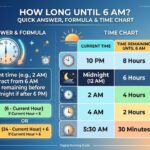
To find how many hours till 6 AM, subtract the current time from 6:00 AM. If it’s already after midnight, that’s all you do: at 2 AM, you have 4 hours left. If it’s still evening, add the hours left until midnight to 6. At 10 PM, that’s 2 + 6 = 8 hours.
Quick Reference: Hours Until 6 AM
Find the time it is now in the left column. The right column shows the time left until 6:00 AM.
Evening and Overnight (the Most Common Search)
| Current Time | 24-Hour Clock | Hours Until 6 AM |
| 6:00 PM | 18:00 | 12 hours |
| 7:00 PM | 19:00 | 11 hours |
| 8:00 PM | 20:00 | 10 hours |
| 9:00 PM | 21:00 | 9 hours |
| 10:00 PM | 22:00 | 8 hours |
| 11:00 PM | 23:00 | 7 hours |
| 12:00 AM (midnight) | 00:00 | 6 hours |
| 1:00 AM | 01:00 | 5 hours |
| 2:00 AM | 02:00 | 4 hours |
| 3:00 AM | 03:00 | 3 hours |
| 4:00 AM | 04:00 | 2 hours |
| 5:00 AM | 05:00 | 1 hour |
Daytime (When “6 AM” Means Tomorrow)
| Current Time | 24-Hour Clock | Hours Until 6 AM Tomorrow |
| 6:00 AM | 06:00 | 24 hours |
| 8:00 AM | 08:00 | 22 hours |
| 10:00 AM | 10:00 | 20 hours |
| 12:00 PM (noon) | 12:00 | 18 hours |
| 2:00 PM | 14:00 | 16 hours |
| 4:00 PM | 16:00 | 14 hours |
| 5:00 PM | 17:00 | 13 hours |
How to Calculate Hours Until 6 AM
There are two simple methods. Pick the one that feels natural.
Method 1: The 12-Hour Clock
This works well when you read AM and PM times.
- If it’s AM and before 6: subtract the hour from 6. At 3 AM, 6 − 3 = 3 hours.
- If it’s PM: find the hours left until midnight (12 minus the hour), then add 6. At 9 PM, 3 + 6 = 9 hours.
The midnight step trips most people up, so don’t skip it. The clock resets there.
Method 2: The 24-Hour Clock
Military-style time makes the math cleaner. Use this rule:
- Before 06:00: 6 − current hour
- After 06:00: 30 − current hour
At 22:00, 30 − 22 = 8 hours. At 01:00, 6 − 1 = 5 hours. The “30” is just 24 hours plus the 6 you’re counting toward.
Comparing the Two Methods
| Feature | 12-Hour Method | 24-Hour Method |
| Best for | Everyday use | Shift workers, travelers, pilots |
| Midnight crossing | Must add two steps | Handled by one formula |
| Chance of error | Higher (AM/PM mix-ups) | Lower |
| Example (11 PM) | 1 + 6 = 7 hours | 30 − 23 = 7 hours |
What If It’s Not Exactly on the Hour?
Real life rarely gives you a clean number. Here’s the easy trick: borrow an hour and turn it into 60 minutes.
Say it’s 2:45 AM.
- Start with 6:00 and subtract 2:45.
- Borrow one hour from the 6, so it becomes 5:60.
- Now subtract: 5:60 − 2:45 = 3 hours 15 minutes.
Worked Examples
| Current Time | Calculation | Time Left |
| 11:40 PM | 20 min to midnight + 6 hrs | 6 hrs 20 min |
| 1:30 AM | 6:00 − 1:30 | 4 hrs 30 min |
| 2:45 AM | 5:60 − 2:45 | 3 hrs 15 min |
| 4:20 AM | 5:60 − 4:20 | 1 hr 40 min |
| 5:35 AM | 5:60 − 5:35 | 25 minutes |
To convert to minutes, multiply the hours by 60. For example, 3 hours 15 minutes is 195 minutes.
How Many Sleep Cycles Fit Before 6 AM?
If you’re heading to bed, the number of hours matters less than how you wake up. A full sleep cycle lasts roughly 90 minutes, though it varies from person to person. Waking in the middle of deep sleep often leaves you groggy.
Adults generally need about 7 to 9 hours of sleep, according to major sleep medicine guidelines. Here’s how bedtime lines up with a 6 AM wake-up.
| Bedtime | Hours of Sleep | Sleep Cycles | How It Usually Feels |
| 9:00 PM | 9 hours | 6 | Fully rested |
| 10:30 PM | 7.5 hours | 5 | Ideal for most adults |
| 12:00 AM | 6 hours | 4 | Okay, but short |
| 1:30 AM | 4.5 hours | 3 | Groggy and low energy |
| 3:00 AM | 3 hours | 2 | Very tired |
Remember that most people need 10 to 20 minutes to fall asleep. If you want 7.5 hours of real sleep, get into bed around 10:15 PM.
Real-Life Scenarios
You Can’t Sleep
It’s 3 AM and you’re wide awake. You have 3 hours until 6. Try not to watch the clock, since checking it can raise stress and make sleep harder. Turn the clock away, keep the room dark, and rest even if sleep doesn’t come right away.
You’re on Night Shift
Night workers often count down to the end of a shift at 6 AM. Many people find the hardest stretch falls in the last couple of hours, when the body’s natural dip in alertness peaks. Plan harder tasks earlier in the shift when you can.
If you drive home afterward, be extra careful. Drowsy driving is a real safety risk.
You’re Planning an Early Flight or Commute
Count backward, not forward. If you need to leave at 6 AM and want a 45-minute buffer to shower and eat, your real deadline is 5:15 AM. Then work out your bedtime from there.
You’re in a Different Time Zone
“6 AM” depends on where you are. If you’re asking about a call or deadline in another city, convert the time zone first, then count the hours.
| Your Location | Local Time | 6 AM in Pakistan (PKT) Is… |
| Islamabad (PKT, UTC+5) | 6:00 AM | 6:00 AM |
| Dubai (UTC+4) | 5:00 AM | 5:00 AM there |
| London (UTC+0, winter) | 1:00 AM | 1:00 AM there |
| New York (UTC−5, winter) | 8:00 PM (previous day) | 8:00 PM there |
Daylight saving time changes these gaps twice a year in places that use it, so double-check on the night the clocks shift.
Common Mistakes (and Fixes)
The most frequent errors come from midnight and AM/PM confusion.
Mistakes to Avoid
- Forgetting midnight. Subtracting 6 − 11 gives a negative number. Always go through 12 first.
- Mixing up 12 AM and 12 PM. 12 AM is midnight. 12 PM is noon.
- Ignoring minutes. Rounding 2:50 AM to “3 AM” makes you think you have 3 hours when you have 3 hours 10 minutes.
- Counting from the wrong 6 AM. At 7 AM, the next 6 AM is a full 23 hours away, not “1 hour ago.”
Do’s and Don’ts
| Do | Don’t |
| Use the 24-hour clock for tricky math | Guess in your head when you’re tired |
| Add buffer time for getting ready | Plan to wake at the exact minute you must leave |
| Count backward to set your bedtime | Count sleep from the moment you lie down |
| Check the time zone for calls and flights | Assume 6 AM means the same everywhere |
Related Terms You’ll See
| Term | Meaning |
| AM / PM | Ante meridiem (before noon) and post meridiem (after noon) |
| 24-hour clock | A system that counts hours from 00 to 23, with no AM or PM |
| Sleep cycle | A roughly 90-minute pattern of light, deep, and REM sleep |
| Circadian rhythm | Your body’s internal 24-hour clock, guided mainly by light |
| Sleep debt | The gap between the sleep you need and the sleep you get |
| Time zone offset | How many hours a place is ahead of or behind UTC |
FAQs
How many hours until 6 AM if it’s 12 AM?
Six hours. Midnight to 6 AM is a clean six-hour stretch.
How many hours until 6 AM from 11 PM?
Seven hours: 1 hour to midnight plus 6 more.
How many minutes until 6 AM from 4 AM?
120 minutes, which is 2 hours.
Is 6 AM morning or night?
Morning. Sunrise usually falls near this time in many places, though it shifts by season and location.
Is 4 or 5 hours of sleep enough?
For most adults, no. It’s fine as a one-off, but regular short sleep can affect mood, focus, and health.
How do I work this out fast without a calculator?
Use the 24-hour clock. If the hour is below 6, subtract it from 6. If it’s above 6, subtract it from 30.
Conclusion
Finding how many hours till 6 AM comes down to one trick: handle midnight first. After midnight, subtract from 6. Before midnight, add the hours to 12 and then add 6.
Use the tables above when you’re too tired to think. If you’re going to bed, work backward from 6 AM in 90-minute steps. Aiming for 7.5 hours of sleep gives you a good chance of waking up clear-headed.