
You glance at the clock and wonder, how long until 2:30? Maybe a class, a bus, a meeting, or a medicine dose is waiting at that time. The answer changes every minute, so the smart move is to learn the simple math behind it.
This guide gives you a fast formula, ready-made charts, and real examples. You will also learn how to avoid the AM and PM mix-up. By the end, you can work out the time left until 2:30 in about five seconds.
Quick Answer: How Long Until 2:30?
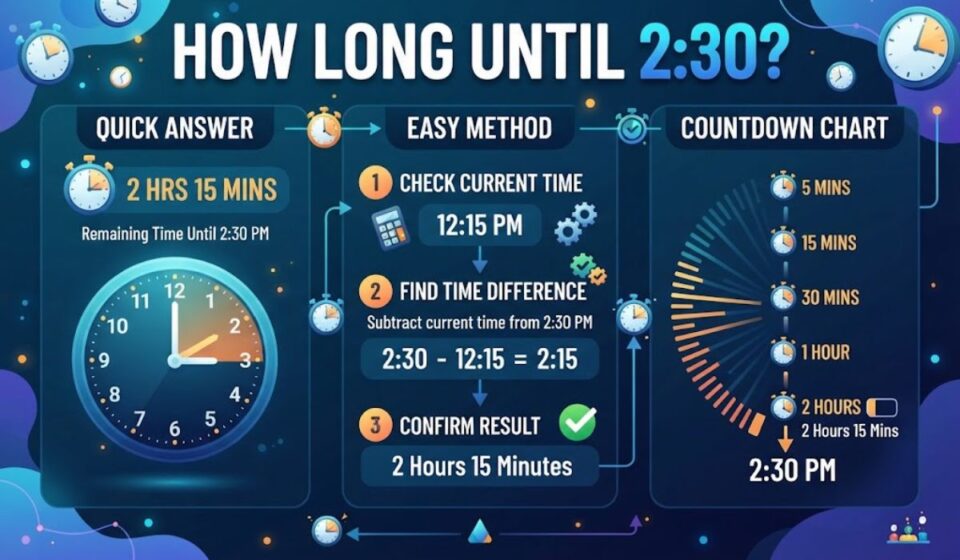
Answer Block: To find how long until 2:30, subtract the current time from 2:30. For example, at 1:30 the wait is exactly 1 hour. If 2:30 has already passed, count forward to the next one. Always check AM or PM first, because 2:30 AM and 2:30 PM are 12 hours apart.
I can’t see your clock, so I can’t name your exact countdown. But the charts below cover most starting times. Find your current time in the left column and read across.
At-a-Glance Summary
| Detail | Value |
| Target time | 2:30 (02:30 AM or 14:30 PM) |
| 2:30 AM in minutes after midnight | 150 minutes |
| 2:30 PM in minutes after midnight | 870 minutes |
| Gap between 2:30 AM and 2:30 PM | 12 hours |
| Gap between two 2:30 AM times | 24 hours |
| Fastest method | Subtract current time from target time |
Table of Contents Summary
Here is what you will find in this guide:
- A quick countdown chart for 2:30 PM
- A quick countdown chart for 2:30 AM
- What to do if 2:30 already passed
- A step-by-step subtraction method
- Mental math shortcuts
- 12-hour vs 24-hour clock differences
- Time zones and daylight saving
- Common mistakes and do’s and don’ts
- FAQs and a final takeaway
Countdown Chart: How Long Until 2:30 PM?
Most people who search this phrase mean the afternoon time. So let’s start there. The chart below shows the time remaining from common starting points.
Morning and Early Afternoon Starts
| Current Time | Time Until 2:30 PM | Total Minutes |
| 8:00 AM | 6 hours 30 minutes | 390 |
| 9:00 AM | 5 hours 30 minutes | 330 |
| 10:00 AM | 4 hours 30 minutes | 270 |
| 11:00 AM | 3 hours 30 minutes | 210 |
| 12:00 PM (noon) | 2 hours 30 minutes | 150 |
| 1:00 PM | 1 hour 30 minutes | 90 |
| 2:00 PM | 30 minutes | 30 |
The Final Stretch
| Current Time | Time Until 2:30 PM |
| 2:10 PM | 20 minutes |
| 2:15 PM | 15 minutes |
| 2:20 PM | 10 minutes |
| 2:25 PM | 5 minutes |
| 2:29 PM | 1 minute |
Notice the pattern. Once you pass 2:00, the answer is just 30 minus the current minutes. At 2:12, that means 18 minutes left.
Countdown Chart: How Long Until 2:30 AM?
The overnight version works the same way, but you cross midnight. That is where many people slip up. Count to midnight first, then add the 2 hours and 30 minutes after it.
| Current Time | Time Until 2:30 AM | Total Minutes |
| 8:00 PM | 6 hours 30 minutes | 390 |
| 9:00 PM | 5 hours 30 minutes | 330 |
| 10:00 PM | 4 hours 30 minutes | 270 |
| 11:00 PM | 3 hours 30 minutes | 210 |
| 12:00 AM (midnight) | 2 hours 30 minutes | 150 |
| 1:00 AM | 1 hour 30 minutes | 90 |
| 2:00 AM | 30 minutes | 30 |
Interesting detail: the numbers match the afternoon chart. That is because 2:30 AM and 2:30 PM both sit 150 minutes after a 12 o’clock mark.
What If 2:30 Already Passed?
Then you are counting to the next one. Here is how that looks at 3:30.
| Current Time | Next 2:30 | Wait Time |
| 3:30 PM | 2:30 AM (tomorrow) | 11 hours |
| 3:30 PM | 2:30 PM (tomorrow) | 23 hours |
| 3:30 AM | 2:30 PM (today) | 11 hours |
| 3:30 AM | 2:30 AM (tomorrow) | 23 hours |
Step-by-Step Method to Calculate Time Until 2:30
You do not need a calculator. Follow these steps and you will get the right answer every time.
- Pick the right 2:30. Decide if you mean AM or PM.
- Write both times in 24-hour format. 2:30 PM becomes 14:30. 2:30 AM stays 02:30.
- Subtract the current time. Subtract minutes first, then hours.
- Borrow an hour if needed. If the minutes are too small, take 60 from the hours.
Worked Examples
Example 1: Same-day afternoon. It is 10:45 AM. You want 2:30 PM.
- Minutes: 30 is smaller than 45, so borrow an hour. That makes 90 minus 45 = 45 minutes.
- Hours: 14 minus 1 (borrowed) minus 10 = 3 hours.
- Answer: 3 hours 45 minutes.
- Check it: 10:45 plus 3:45 lands on 14:30.
Example 2: Overnight. It is 9:50 PM. You want 2:30 AM.
- Treat 2:30 AM as 26:30 (that is 24 + 2:30).
- 26:30 minus 21:50 = 4 hours 40 minutes.
Example 3: Easy minutes. It is 12:10 PM. You want 2:30 PM.
- Minutes: 30 minus 10 = 20.
- Hours: 14 minus 12 = 2.
- Answer: 2 hours 20 minutes.
Step-by-Step Breakdown Table
| Step | Action | Example (10:45 AM to 2:30 PM) |
| 1 | Choose AM or PM | 2:30 PM |
| 2 | Convert to 24-hour time | 14:30 and 10:45 |
| 3 | Borrow if minutes are short | 90 minus 45 = 45 min |
| 4 | Subtract hours | 13 minus 10 = 3 hours |
| 5 | Combine | 3 hours 45 minutes |
Mental Math Shortcuts
Speed helps when you are in a hurry. These tricks work well in your head.
- Hop to the next half hour. From 10:45, you need 45 minutes to reach 11:30. Then count 3 more hours to 2:30. Total: 3 hours 45 minutes.
- Use the half hour rule. 2:30 is always halfway between 2:00 and 3:00. Find the time to 2:00, then add 30.
- Think in minutes. Convert everything to minutes when the gap is small. It is easier to say “45 minutes” than “0.75 hours.”
The half hour rule is my favorite. Say it is 12:40. Time to 2:00 is 80 minutes. Add 30 and you get 110 minutes, or 1 hour 50 minutes.
12-Hour vs 24-Hour Clock: Why It Matters
Confusion often starts with the clock format. A 12-hour clock repeats the numbers 1 to 12 twice a day. A 24-hour clock (also called military time) never repeats.
The 24-hour style removes the AM and PM guesswork. That is why airlines, hospitals, and train schedules prefer it.
Format Comparison
| Term | 12-Hour Format | 24-Hour Format |
| Early morning 2:30 | 2:30 AM | 02:30 |
| Afternoon 2:30 | 2:30 PM | 14:30 |
| Typical use | Daily life, phones | Transport, medicine, military |
| AM/PM needed? | Yes | No |
| Risk of mix-up | Higher | Lower |
Real-Life Situations Where This Question Comes Up
People ask this for very practical reasons. Here are the most common ones.
- School and work: A class, lunch break, or meeting starts at 2:30 PM, and you need to plan your time.
- Transport: A bus, train, or flight leaves at 2:30 and you want to leave on time.
- Health: A medicine dose or a timed treatment is due at 2:30.
- Appointments: A doctor visit, interview, or call is booked for 2:30.
- Late night tasks: A download, update, or night shift ends at 2:30 AM.
Related Terms Worth Knowing
| Term | Simple Meaning |
| Elapsed time | How much time has passed between two moments |
| Time difference | The gap between two clock times |
| Countdown timer | A tool that counts down to a set time |
| Time zone | A region that shares the same standard time |
| UTC | The global time standard used to compare zones |
| Daylight saving time | A seasonal clock shift, usually by one hour |
Time Zones and Daylight Saving: The Hidden Trap
Your answer depends on your local clock. If you are joining a call in another city, the 2:30 may be in their time zone, not yours. Always confirm which zone the person means.
Daylight saving time can also change the count. In many regions, the clock jumps forward at 2:00 AM in spring. That means 2:30 AM may not exist at all on that night.
In regions that “fall back,” the clock repeats an hour in the early morning. Most of the year this will not matter. But on clock-change nights, double check with your phone.
Quick Time Zone Conversion
| If It Is 2:30 PM In | Then It Is (Standard Time) |
| New York (ET) | 11:30 AM in Los Angeles (PT) |
| New York (ET) | 7:30 PM in London (GMT) |
| London (GMT) | 9:30 AM in New York (ET) |
| UTC | 7:30 PM in Karachi (PKT) |
Daylight saving can shift these gaps by an hour, so verify before you plan around them.
Fastest Ways to Get a Live Answer
Doing the math is great. But a device can confirm it in seconds.
- Voice assistant: Say, “Set a timer until 2:30” or “Wake me at 2:30.”
- Phone alarm: Set an alarm for 2:30. Most phones show how long until it rings.
- Clock app: Use the timer or world clock feature for other time zones.
- Smartwatch: Ask for a countdown and let it buzz you.
The phone alarm trick is underrated. It does the subtraction for you the moment you save the alarm.
Common Mistakes and Do’s & Don’ts
Small slips cause big scheduling problems. Watch out for these.
Common Mistakes
- Mixing up AM and PM, which creates a 12 hour error.
- Forgetting that an hour has 60 minutes, not 100.
- Reading 2:30 as 2.30 hours, which is 2 hours 18 minutes, not 2 hours 30.
- Ignoring midnight when counting overnight.
- Assuming 2:30 has not passed when it already has.
Do’s and Don’ts
| Do | Don’t |
| Confirm AM or PM before counting | Assume the time is always PM |
| Convert to 24-hour time for long gaps | Subtract hours and minutes as decimals |
| Set a phone alarm for important times | Rely only on memory |
| Add a 5 to 10 minute buffer | Plan to arrive at exactly 2:30 |
| Check the time zone for calls | Assume everyone shares your clock |
| Verify on clock-change nights | Trust mental math during daylight saving shifts |
A quick example shows the risk. If you say “see you at 2:30” and your friend thinks AM while you mean PM, one of you waits half a day. A single word, “afternoon” or “overnight,” clears it up.
Frequently Asked Questions
How long until 2:30 from now?
Subtract the current time from 2:30. If it is 1:30, the wait is 1 hour. If it is 2:00, the wait is 30 minutes.
How many minutes are in 2 hours 30 minutes?
There are 150 minutes. That is 120 plus 30.
Is 2:30 AM or PM?
It can be either. 2:30 AM is deep night (02:30), and 2:30 PM is afternoon (14:30).
How long from 2:30 PM to 2:30 AM?
It is 12 hours. Both times sit exactly half a day apart.
What is 2:30 PM in 24-hour time?
It is 14:30. Simply add 12 to the hour.
How do I count down to 2:30 on my phone?
Set an alarm for 2:30 and check how long until it rings. You can also ask your voice assistant to set a timer.
Does daylight saving change the wait until 2:30?
Yes, but only on clock-change nights. The gap may grow or shrink by one hour.
Conclusion
Finding out how long until 2:30 is simple once you know the pattern. Pick AM or PM, subtract the current time, and borrow an hour if the minutes fall short. Use the charts above for a fast lookup, and lean on the half hour trick for quick mental math.
Here is your takeaway. Confirm AM or PM, watch the time zone, and set a phone alarm for anything important. A five second check saves you from a missed bus, a late meeting, or a very long wait.