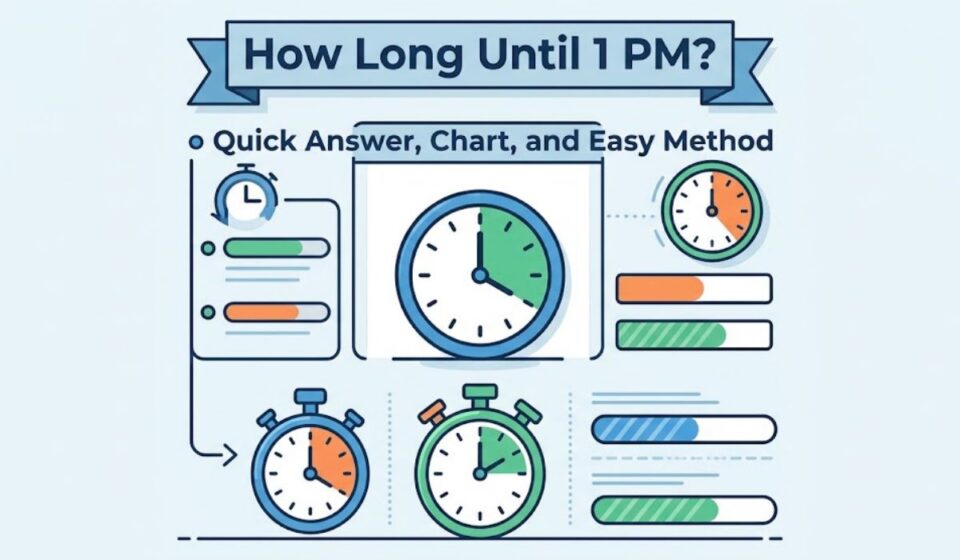

You glance at the clock and wonder, how long until 1 PM? Maybe lunch is close. Maybe a meeting starts then. Maybe you just want the morning to move faster.
This guide gives you the answer in seconds. You’ll get a lookup chart, a simple formula, real examples, and fixes for the mistakes people make most.
Quick Answer: How Long Until 1 PM?
To find how long until 1 PM, subtract the current time from 13:00. If it is 10:30 AM, you have 2 hours and 30 minutes left. After 1 PM has passed, count to 1 PM tomorrow instead: subtract the current time from 24 hours, then add 13 hours.
That’s the whole idea. The rest of this article makes it faster and error-proof.
Overview of What You’ll Learn
| Section | What You Get |
| Quick lookup chart | Instant answers from 8 AM to 12:55 PM |
| 3-step method | A formula that works at any time of day |
| After 1 PM | How to count to 1 PM tomorrow |
| Time zones | What 1 PM means in other cities |
| Mistakes | Common errors and how to avoid them |
| FAQs | Short answers to related questions |
Quick Reference Chart: Time Left Until 1 PM Today
Find your current time in the left column. The rest of the row is your answer.
| Current Time | Time Left | Total Minutes | Total Seconds |
| 8:00 AM | 5 hr 0 min | 300 | 18,000 |
| 9:30 AM | 3 hr 30 min | 210 | 12,600 |
| 10:45 AM | 2 hr 15 min | 135 | 8,100 |
| 11:15 AM | 1 hr 45 min | 105 | 6,300 |
| 12:00 PM (noon) | 1 hr 0 min | 60 | 3,600 |
| 12:30 PM | 30 min | 30 | 1,800 |
| 12:45 PM | 15 min | 15 | 900 |
| 12:55 PM | 5 min | 5 | 300 |
Your time not listed? Pick the closest row, then adjust by the minutes of difference.
How to Calculate Time Until 1 PM (3 Easy Steps)
You don’t need an app. Basic subtraction does the job. Here’s the method.
Step 1: Switch to 24-Hour Time
1 PM is 13:00 on a 24-hour clock. Convert your current time too. Any PM hour just adds 12. So 11:20 AM stays 11:20, and 12:20 PM stays 12:20.
Step 2: Subtract the Current Time From 13:00
Take 13:00 and subtract. If the minutes are tricky, use the “next hour” shortcut:
- Find the minutes left until the next full hour (60 minus the current minutes).
- Count the full hours from that next hour up to 13:00.
- Add the two pieces.
Step 3: Check Your Answer
Add your result back to the current time. You should land exactly on 1:00 PM. This takes five seconds and catches most slips.
Worked Examples
| Current Time | Calculation | Result |
| 9:15 AM | 45 min to 10:00, then 3 hr to 1:00 | 3 hr 45 min |
| 10:40 AM | 20 min to 11:00, then 2 hr to 1:00 | 2 hr 20 min |
| 11:50 AM | 10 min to 12:00, then 1 hr to 1:00 | 1 hr 10 min |
| 12:20 PM | 40 min to 1:00 | 40 min |
Say it’s 10:40 AM. That’s 2 hours 20 minutes. In seconds, that is 8,400, because 140 minutes times 60 equals 8,400.
What If 1 PM Has Already Passed?
This is where most people slip. Once the clock reads 1:01 PM, “until 1 PM” means tomorrow.
The trick: count from now to midnight, then add 13 hours.
Time Until 1 PM Tomorrow
| Current Time | Hours Until 1 PM Tomorrow |
| 1:10 PM | 23 hr 50 min |
| 2:00 PM | 23 hr |
| 6:00 PM | 19 hr |
| 9:00 PM | 16 hr |
| 12:00 AM (midnight) | 13 hr |
| 6:00 AM | 7 hr |
Quick tip: at 1:00 PM exactly, the answer is zero if you mean now, or 24 hours if you mean tomorrow. Say which one you mean when you set plans with others.
Common Variations of This Question
People search this phrase in many forms. Each one is the same math with a different target or window.
| Search Phrase | What It Means | How to Solve |
| How long until 1 PM today | Time to 13:00 today | Subtract now from 13:00 |
| How long until 1 PM tomorrow | Time to 13:00 next day | Time to midnight + 13 hr |
| How long until 1:30 PM | Target is 13:30 | Subtract now from 13:30 |
| How many hours until 1 PM | Whole hours only | Round the result down or up |
| How many minutes until 1 PM | Convert to minutes | Hours × 60 + extra minutes |
| How many hours is 10 AM to 1 PM | A fixed span | 3 hours |
For a 1:30 PM target, just add 30 minutes to any answer from the chart above.
Why You Count Down to 1 PM
Real life gives this question plenty of reasons. A few common ones:
- Lunch breaks. Many offices schedule lunch around noon to 1 PM.
- Meetings and calls. Early afternoon is a popular slot because it avoids the morning rush.
- Deadlines. Some tasks are due “by 1 PM” so work can be reviewed the same day.
- Appointments. Clinics, banks, and government offices often split their day around midday.
- School and exam schedules. Half-day sessions often end near this hour.
Use the Countdown to Plan Your Work
Knowing the exact gap helps you split work into blocks. Say you have two hours left. That fits four 25-minute focus sessions, each followed by a 5-minute break. With 45 minutes left, you can finish one small task rather than start a big one.
A simple rule works well: if you have under 30 minutes, use the time to prepare for what comes next instead of starting something new.
1 PM Across Time Zones
“1 PM” depends on where you are. If you’re coordinating with someone far away, convert first, then count down. The table below uses standard time offsets.
| City | UTC Offset | Local Time When It’s 1 PM UTC |
| London | UTC+0 | 1:00 PM |
| New York | UTC−5 | 8:00 AM |
| Dubai | UTC+4 | 5:00 PM |
| Karachi | UTC+5 | 6:00 PM |
| Delhi | UTC+5:30 | 6:30 PM |
| Tokyo | UTC+9 | 10:00 PM |
Daylight saving time shifts some of these by one hour for part of the year. Clock-change weekends can add or remove an hour from your countdown. Always check the date when your plan crosses a clock change.
Real-life example: a team lead in London schedules a call for 1 PM London time (standard time). A teammate in Tokyo sees 10 PM. A teammate in New York sees 8 AM. Each person counts a different gap, even though it is the same moment.
Related Terms and Concepts
These terms often appear next to this topic. Knowing them keeps your math clean.
| Term | Meaning |
| 13:00 | 1 PM in 24-hour (military) time |
| Noon | 12:00 PM, the midpoint of the day |
| Midnight | 12:00 AM, the start of a new day |
| AM / PM | Short for ante meridiem (before midday) and post meridiem (after midday) |
| Elapsed time | The amount of time that passes between two moments |
| Time interval | The gap between a start time and an end time |
| Countdown timer | A tool that shows time left, live, to a set moment |
| Time zone | A region that shares one standard clock time |
Do’s and Don’ts When Counting to 1 PM
Small mistakes turn into missed calls and late arrivals. Use this table as a checklist.
| Do | Don’t |
| Convert to 24-hour time first | Mix AM and PM in your head |
| Confirm the time zone in shared plans | Assume everyone shares your clock |
| Check your answer by adding it back | Trust a rough guess for deadlines |
| Add a 10 to 15 minute buffer for travel or setup | Plan to arrive exactly at 1:00 |
| Say “1 PM today” or “1 PM tomorrow” | Leave the day unclear |
The Mistakes That Trip People Up
Treating 12 as the start of the PM cycle. At 12:30 PM, the clock “restarts” at 12, not 1. This makes the gap feel bigger than it is. At 12:30 PM, you have only 30 minutes left.
Forgetting the day change. After 1 PM, asking “how long until 1 PM” means tomorrow. Many people subtract and get a negative number, then get stuck.
Ignoring the buffer. If you need to commute, log in, or prepare, your real deadline is earlier than 1 PM. Count down to the moment you must start, not the moment the event begins.
Skipping the time zone. A “1 PM” invite with no zone listed causes confusion. Add the zone every time.
Best Tools for a Live Countdown
Math works, but sometimes you want a live display. Here are your options.
| Tool | Best For | Pros | Cons |
| Phone timer or clock app | Quick personal use | Always with you, no setup | Needs you to calculate the length first |
| Smart assistant | Hands-free answers | Fast, just ask | Needs a voice-enabled device |
| Online countdown page | Live seconds-level display | Updates automatically | Needs a browser |
| Calendar alert at 12:45 PM | Reminders | Never miss the moment | Doesn’t show a running count |
For most people, a calendar alert set 10 to 15 minutes early works best. It handles the buffer for you.
Frequently Asked Questions
How many hours until 1 PM?
Subtract the current time from 13:00. At 9 AM, it is 4 hours. At 11 AM, it is 2 hours.
How many minutes until 1 PM?
Multiply the hours left by 60, then add the extra minutes. At 11:45 AM, you have 1 hour 15 minutes, which is 75 minutes.
How many seconds until 1 PM?
Multiply the minutes by 60. For 75 minutes, that is 4,500 seconds.
How long is it from 10 AM to 1 PM?
It is exactly 3 hours, or 180 minutes.
Is 1 PM the same as 13:00?
Yes. Add 12 to any PM hour (except 12 PM) to get 24-hour time. So 1 PM becomes 13:00.
How long until 1 PM tomorrow?
Count the time left until midnight, then add 13 hours. At 6 PM, that is 6 hours plus 13, which equals 19 hours.
Conclusion
Working out how long until 1 PM comes down to one move: subtract your current time from 13:00. Convert to 24-hour time first, use the chart for fast answers, and check your result by adding it back.
After 1 PM passes, switch to the tomorrow method. Add a small buffer, and confirm the time zone when other people are involved. Keep the quick reference chart handy, and you’ll never need to second-guess the clock again.