
Ever look at the clock and wonder how long until 1 PM? It happens to everyone. Maybe lunch, a call, or an appointment is coming up.
The answer is easy to find. Take the current time and subtract it from 1:00 PM, or 13:00 on a 24 hour clock. If it is 10:00 AM, you have 3 hours left. If it is 12:15 PM, you have just 45 minutes.
This guide gives you a quick formula, a simple time chart, and tips to avoid mistakes. You will also learn how time zones and clock formats can change your answer. Let’s get started.
Quick Answer: How Long Until 1 PM?
To find how long until 1 PM, subtract the current time from 1:00 PM (13:00). If it’s 10:00 AM, you have 3 hours left. If it’s 12:15 PM, you have 45 minutes. After 1:00 PM, the next 1 PM is tomorrow.
Your phone’s clock is the fastest check. The method below works anywhere, even offline.
How to Calculate Time Until 1 PM
You only need one number: 13:00. That’s 1 PM on a 24-hour clock. Subtract your current time from it.
The 3-Step Method
- Convert to 24-hour time. Add 12 to any PM hour (11 AM stays 11:00, but 12 PM stays 12:00).
- Subtract from 13:00. Take the hour gap first.
- Fix the minutes. If the minutes aren’t zero, borrow an hour and subtract from 60.
Example: It’s 9:25 AM.
- From 9:25 to 10:00 is 35 minutes.
- From 10:00 to 1:00 PM is 3 hours.
- Total: 3 hours 35 minutes.
That’s the whole trick. After a few tries, you’ll do it in your head.
The Shortcut for Whole Hours
If the clock shows a whole hour before 1 PM, count the hours between.
- 12:00 PM → 1 hour
- 11:00 AM → 2 hours
- 9:00 AM → 4 hours
The Shortcut for Minutes
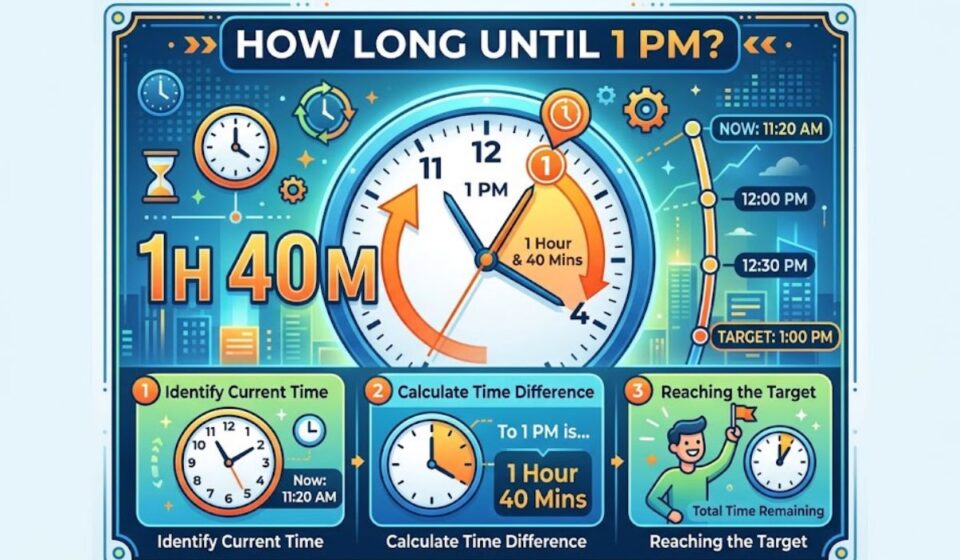
When there are extra minutes, count up to the next hour, then add the rest. At 11:40 AM, you need 20 minutes to reach 12:00, plus 1 hour to reach 1:00. Total: 1 hour 20 minutes.
At-a-Glance Reference Chart
Use this table when you just want the number. It covers the morning and early afternoon hours when people most often ask.
| Current Time | 24-Hour Format | Time Until 1 PM |
| 6:00 AM | 06:00 | 7 hours |
| 7:00 AM | 07:00 | 6 hours |
| 8:00 AM | 08:00 | 5 hours |
| 9:00 AM | 09:00 | 4 hours |
| 10:00 AM | 10:00 | 3 hours |
| 11:00 AM | 11:00 | 2 hours |
| 12:00 PM (noon) | 12:00 | 1 hour |
| 12:30 PM | 12:30 | 30 minutes |
| 12:45 PM | 12:45 | 15 minutes |
Bookmark this chart. It covers most real-world questions.
Minutes and Seconds Breakdown
Sometimes you need a different unit. Maybe you’re setting a timer or planning a lunch meeting.
Hours Converted to Minutes and Seconds
| Hours Left | Minutes | Seconds |
| 1 hour | 60 | 3,600 |
| 2 hours | 120 | 7,200 |
| 3 hours | 180 | 10,800 |
| 4 hours | 240 | 14,400 |
| 5 hours | 300 | 18,000 |
| 6 hours | 360 | 21,600 |
| 7 hours | 420 | 25,200 |
Final Stretch Checkpoints
For the last hour before 1 PM, these are the checkpoints most people use.
| Clock Reads | Time Remaining |
| 12:15 PM | 45 minutes |
| 12:30 PM | 30 minutes |
| 12:45 PM | 15 minutes |
| 12:50 PM | 10 minutes |
| 12:55 PM | 5 minutes |
12-Hour vs. 24-Hour Clock
Mixing up the two formats causes many calculation errors. Here’s how they line up.
| 12-Hour Clock | 24-Hour Clock | Notes |
| 1:00 AM | 01:00 | Middle of the night |
| 12:00 PM | 12:00 | Noon |
| 12:00 AM | 00:00 | Midnight |
| 1:00 PM | 13:00 | Your target time |
| 1:00 PM (military) | 1300 hours | Spoken as “thirteen hundred” |
A quick rule: for any PM time from 1 to 11, add 12. For 12 PM, keep it as 12.
If you work with military or international schedules, 24-hour time makes every calculation easier. You never have to guess AM or PM.
Time Zones and 1 PM
“1 PM” always means 1 PM where you are, unless someone says otherwise. This matters for calls, webinars, and deadlines.
If a friend says “the call is at 1 PM EST” and you live elsewhere, convert first, then subtract.
Sample Conversions
These assume standard time with no daylight saving shifts. Your local rules may differ.
| If It’s 1 PM In… | UTC Offset | Pakistan Time (PKT, UTC+5) |
| New York (EST) | UTC−5 | 11:00 PM same day |
| London (GMT) | UTC+0 | 6:00 PM |
| Dubai (GST) | UTC+4 | 2:00 PM |
| Karachi / Lahore (PKT) | UTC+5 | 1:00 PM |
Always check whether daylight saving time is in effect. It shifts many regions by an hour for part of the year and causes plenty of “I missed it by an hour” stories.
Real-Life Examples
Numbers feel abstract. Here’s how the math plays out in everyday situations.
Planning a Lunch Break
Your lunch starts at 1 PM and it’s 10:45 AM now. You have 2 hours 15 minutes. Use that time for one focused block of work, then wrap up by 12:45 PM.
Catching a Midday Appointment
Your appointment is at 1 PM and the drive takes 25 minutes. Leave by 12:35 PM. Add a 10-minute buffer for parking, and 12:25 PM is safer.
Joining a Webinar or Call
A video call starts at 1 PM. At 11:30 AM, you have 1 hour 30 minutes. Test your camera and audio by 12:45 PM so nothing surprises you.
Meal Prep Against the Clock
You want lunch on the table at 1 PM, and the dish takes 50 minutes. Start cooking by 12:10 PM. If it needs 10 minutes of resting time, start at noon.
Common Mistakes and Do’s and Don’ts
Most errors come from the same few slips. Here’s how to avoid them.
Common Mistakes
- Forgetting AM vs. PM. 1 AM and 1 PM are twelve hours apart.
- Subtracting minutes wrong. From 11:50 to 1:00 is 1 hour 10 minutes, not 1 hour 50.
- Mishandling noon. 12:00 PM is noon, so 1 PM is just one hour later.
- Ignoring time zones. A shared 1 PM call may not be 1 PM for you.
- Forgetting it’s already past. After 1:00 PM, the next one is tomorrow.
Do’s and Don’ts
| ✅ Do | ❌ Don’t |
| Convert to 24-hour time first | Mix 12-hour and 24-hour math |
| Count up to the next hour, then add minutes | Subtract minutes straight from hours |
| Confirm the time zone for shared events | Assume everyone’s 1 PM matches yours |
| Add a 10-minute buffer for travel or prep | Plan to arrive exactly at 1:00 |
| Set a phone timer for exact countdowns | Rely on mental math for tight deadlines |
Related Terms and Concepts
These phrases pop up around this topic. Knowing them helps when you search or set reminders.
| Term | Meaning |
| 13:00 | 1 PM in 24-hour format |
| Countdown timer | A tool that counts down to a set time |
| Time remaining | The gap between now and a target time |
| Time difference | The offset between two time zones |
| UTC | The global reference time standard |
| Daylight saving time (DST) | Seasonal clock shift in some regions |
| Elapsed time | How much time has already passed |
| Post meridiem | The Latin phrase behind “PM,” meaning after midday |
Frequently Asked Questions
How many hours until 1 PM from 8 AM?
Five hours. 8:00 AM is 08:00, and 13:00 minus 08:00 equals 5 hours.
How long until 1 PM if it’s 1:30 PM now?
The next 1 PM is tomorrow, so you have 23 hours and 30 minutes.
What time is 1 PM in 24-hour format?
It’s 13:00, often written 1300 in military time.
How many minutes until 1 PM from 12:20 PM?
40 minutes.
Is there a faster way than doing the math?
Yes. Ask your phone’s voice assistant, or set a timer for 1 PM in your clock app. It will count down for you.
Does 1 PM change with daylight saving time?
The label stays the same, but the real-world moment shifts. If clocks move forward an hour, the same moment feels an hour earlier on the clock.
Conclusion
Figuring out how long until 1 PM comes down to one move: subtract your current time from 13:00. Convert PM hours first, count up to the next hour before adding leftover minutes, and double-check your time zone for shared plans.
For a fast answer, use the reference chart above. For exact countdowns, set a timer on your phone. A small buffer never hurts either.