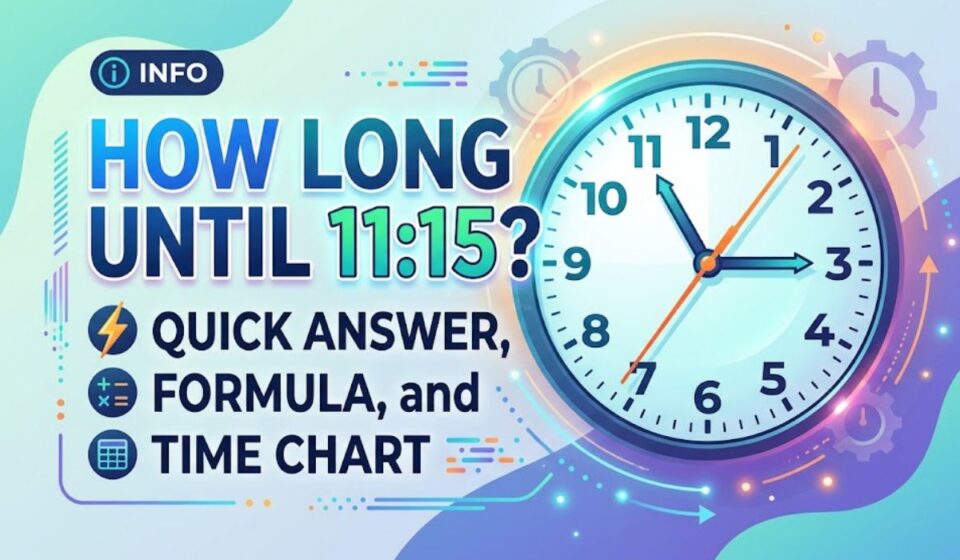

Ever look at the clock and wonder how long until 11:15? It happens to everyone. Maybe you have a meeting, a class, or a bedtime goal coming up.
The answer is easy to find. Take the current time and subtract it from 11:15. If it is 9:15 AM, you have 2 hours left. If it is 10:45 AM, you have just 30 minutes.
This guide gives you a quick formula, a simple time chart, and tips to avoid mistakes. You will also learn how to tell 11:15 AM from 11:15 PM. Let’s get started.
Quick Answer: How Long Until 11:15?
To find how long until 11:15, subtract the current time from 11:15. If it’s 9:15 AM, you have 2 hours left. If it’s 10:45 AM, you have 30 minutes. If 11:15 AM has already passed, the next 11:15 is tonight at 11:15 PM (23:15) or tomorrow morning.
Your phone’s clock is the fastest check. The method below works anywhere, even offline.
How to Calculate Time Until 11:15
You only need your target time in a format you can subtract from. For 11:15 AM that’s 11:15. For 11:15 PM that’s 23:15.
The 3-Step Method
- Pick your target. Decide if you mean 11:15 AM or 11:15 PM.
- Convert to 24-hour time. Add 12 to any PM hour (3 PM becomes 15:00).
- Subtract. Take the hour gap first, then fix the minutes.
Example: It’s 8:40 AM and your target is 11:15 AM.
- From 8:40 to 9:00 is 20 minutes.
- From 9:00 to 11:00 is 2 hours.
- From 11:00 to 11:15 is 15 minutes.
- Total: 2 hours 35 minutes.
The Shortcut for Whole Hours
If the clock shows a whole hour, subtract it from 11, then add 15 minutes.
- 10:00 AM → 1 hour 15 minutes
- 9:00 AM → 2 hours 15 minutes
- 8:00 AM → 3 hours 15 minutes
The Shortcut for Minutes
When there are extra minutes, count up to the next hour, then add the rest. At 9:50 AM, you need 10 minutes to reach 10:00. Then you need 1 hour 15 minutes more. Total: 1 hour 25 minutes.
At-a-Glance Reference Chart
Use this table when you just want the number. It covers the morning stretch before 11:15 AM.
| Current Time | 24-Hour Format | Time Until 11:15 AM |
| 5:00 AM | 05:00 | 6 hours 15 minutes |
| 6:00 AM | 06:00 | 5 hours 15 minutes |
| 7:00 AM | 07:00 | 4 hours 15 minutes |
| 8:00 AM | 08:00 | 3 hours 15 minutes |
| 9:00 AM | 09:00 | 2 hours 15 minutes |
| 10:00 AM | 10:00 | 1 hour 15 minutes |
| 10:30 AM | 10:30 | 45 minutes |
| 10:45 AM | 10:45 | 30 minutes |
| 11:00 AM | 11:00 | 15 minutes |
Bookmark this chart. It covers most real-world questions.
Minutes and Seconds Breakdown
Sometimes you need a different unit. Maybe you’re setting a timer or planning a meeting window.
Common Gaps Converted
| Time Left | Minutes | Seconds |
| 15 minutes | 15 | 900 |
| 30 minutes | 30 | 1,800 |
| 1 hour | 60 | 3,600 |
| 1 hour 15 minutes | 75 | 4,500 |
| 2 hours | 120 | 7,200 |
| 3 hours 15 minutes | 195 | 11,700 |
| 4 hours 15 minutes | 255 | 15,300 |
Final Stretch Checkpoints
For the last hour before 11:15 AM, these are the checkpoints most people use.
| Clock Reads | Time Remaining |
| 10:15 AM | 1 hour |
| 10:30 AM | 45 minutes |
| 10:45 AM | 30 minutes |
| 11:00 AM | 15 minutes |
| 11:10 AM | 5 minutes |
11:15 AM vs. 11:15 PM
This is where most confusion starts. The keyword has no AM or PM, so context decides.
| Feature | 11:15 AM | 11:15 PM |
| 24-hour format | 11:15 | 23:15 |
| Time of day | Late morning | Late night |
| Typical use | Brunch, meetings, appointments | Bedtime, late shows, deadlines |
| Time until midnight | 12 hours 45 minutes | 45 minutes |
| Common search reason | Class, work break, flight | Sleep planning, midnight cutoff |
A quick rule: if you’re searching in the morning, you probably mean AM. If you’re searching in the evening, you probably mean PM.
Time Until 11:15 PM
If your target is 11:15 PM, here’s the evening chart.
| Current Time | 24-Hour Format | Time Until 11:15 PM |
| 5:00 PM | 17:00 | 6 hours 15 minutes |
| 7:00 PM | 19:00 | 4 hours 15 minutes |
| 8:00 PM | 20:00 | 3 hours 15 minutes |
| 9:00 PM | 21:00 | 2 hours 15 minutes |
| 10:00 PM | 22:00 | 1 hour 15 minutes |
| 10:45 PM | 22:45 | 30 minutes |
12-Hour vs. 24-Hour Clock
Mixing up the two formats causes many calculation errors. Here’s how they line up.
| 12-Hour Clock | 24-Hour Clock | Notes |
| 11:15 AM | 11:15 | Late morning |
| 12:00 PM | 12:00 | Noon |
| 12:00 AM | 00:00 | Midnight |
| 11:15 PM | 23:15 | Late evening |
| 11:15 PM (military) | 2315 hours | Spoken as “twenty three fifteen” |
For any PM time from 1 to 11, add 12. For 12 PM, keep it as 12.
If you work with military or international schedules, 24-hour time makes every calculation easier. You never have to guess AM or PM.
Real-Life Examples
Numbers feel abstract. Here’s how the math plays out in everyday situations.
Catching a Late-Morning Appointment
Your appointment is at 11:15 AM and you need 30 minutes to get there. Subtract travel time and leave by 10:45 AM. Add a 10-minute buffer for parking, and 10:35 AM is safer.
Planning a Study or Work Block
It’s 8:15 AM and you have a meeting at 11:15 AM. That gives you exactly 3 hours. Split it into two 90-minute focus blocks with a short break between them.
Timing a Late-Night Cutoff
You want to be in bed by 11:15 PM. At 9:30 PM, you have 1 hour 45 minutes. That’s enough for dinner cleanup, a shower, and a quiet wind-down.
Cooking Against the Clock
Your brunch needs to be ready by 11:15 AM, and the dish takes 45 minutes. Start cooking by 10:30 AM. If it needs 15 minutes of resting time, start at 10:15 AM.
Common Mistakes and Do’s and Don’ts
Most errors come from the same few slips. Here’s how to avoid them.
Common Mistakes
- Mixing up AM and PM. 11:15 AM and 11:15 PM are twelve hours apart.
- Subtracting minutes wrong. From 9:50 to 11:15 is 1 hour 25 minutes, not 1 hour 35.
- Forgetting the 15 minutes. Many people calculate to 11:00 and stop.
- Ignoring time zones. A shared 11:15 call may not be 11:15 for you.
- Forgetting it’s already past. After 11:15, the next one is later or tomorrow.
Do’s and Don’ts
| ✅ Do | ❌ Don’t |
| Confirm AM or PM before you calculate | Assume the keyword means one or the other |
| Count up to the next hour, then add minutes | Subtract minutes straight from hours |
| Convert to 24-hour time for tricky gaps | Mix 12-hour and 24-hour math |
| Add a 10-minute buffer for travel | Plan to arrive exactly at 11:15 |
| Set a phone timer for exact countdowns | Rely on mental math for tight deadlines |
Related Terms and Concepts
These phrases pop up around this topic. Knowing them helps when you search or set reminders.
| Term | Meaning |
| 23:15 | 11:15 PM in 24-hour format |
| Countdown timer | A tool that counts down to a set time |
| Time remaining | The gap between now and a target time |
| Time difference | The offset between two time zones |
| UTC | The global reference time standard |
| Daylight saving time (DST) | Seasonal clock shift in some regions |
| Elapsed time | How much time has already passed |
| Quarter past | The “15” in 11:15, a quarter of an hour past eleven |
Frequently Asked Questions
How many hours until 11:15 AM from 8:15 AM?
Exactly 3 hours. The minutes match, so you only subtract the hours.
How long until 11:15 if it’s 11:30 AM now?
For 11:15 AM, the next one is tomorrow, so you have 23 hours and 45 minutes. For 11:15 PM, you have 11 hours and 45 minutes.
What time is 11:15 PM in 24-hour format?
It’s 23:15, often written 2315 in military time.
How many minutes until 11:15 from 10:50?
25 minutes.
Is there a faster way than doing the math?
Yes. Ask your phone’s voice assistant, or set a timer for 11:15 in your clock app. It will count down for you.
Does 11:15 change with daylight saving time?
The label stays the same, but the real-world moment shifts. If clocks move forward an hour, the same moment feels an hour earlier on the clock.
Conclusion
Figuring out how long until 11:15 comes down to one move: pick AM or PM, then subtract your current time from the target. Convert to 24-hour time when it helps, and count up to the next hour before adding leftover minutes.
For a fast answer, use the reference chart above. For exact countdowns, set a timer on your phone. A small buffer never hurts either.