
You look at the clock and wonder how long until 2:20. Maybe you have a class, a call, or a bus to catch. The answer depends on one thing: the time it is right now.
The math is easy. You take the current time away from 2:20 and you get the wait. This guide gives you quick tricks and simple charts so you can find your answer in seconds, whether you mean day or night.
Quick Answer: How Long Until 2:20?
Subtract the current time from 2:20. At 2:00 you wait 20 minutes, and at 1:20 you wait one hour. Not sure if you mean day or night? Use 14:20 for the afternoon and 02:20 for the night, then subtract.
What’s Inside
| Section | What You’ll Get |
| Cheat sheets | Ready answers for the afternoon and the night |
| The Anchor at 2:00 method | The fastest way to count to 2:20 |
| Crossing noon or midnight | How to split a long countdown |
| Leave by planner | Working backward from travel time |
| Clock time vs. duration | When “2:20” means a length, not a moment |
| Mistakes and FAQs | Quick fixes and common questions |
Cheat Sheet 1: Time Left Until 2:20 PM
Use this when you’re counting to the afternoon 2:20.
| Current Time | Time Left |
| 8:00 AM | 6 hours 20 minutes |
| 9:00 AM | 5 hours 20 minutes |
| 10:00 AM | 4 hours 20 minutes |
| 11:00 AM | 3 hours 20 minutes |
| 12:00 PM (noon) | 2 hours 20 minutes |
| 1:00 PM | 1 hour 20 minutes |
| 1:20 PM | 1 hour |
| 2:00 PM | 20 minutes |
| 2:10 PM | 10 minutes |
| 2:15 PM | 5 minutes |
Every hour you move forward removes exactly one hour from the total.
Cheat Sheet 2: The Final Hour Before 2:20
When the time is close, minutes matter more than hours.
| Current Time | Time Left |
| 1:20 | 60 minutes |
| 1:30 | 50 minutes |
| 1:40 | 40 minutes |
| 1:50 | 30 minutes |
| 2:00 | 20 minutes |
| 2:10 | 10 minutes |
| 2:15 | 5 minutes |
| 2:19 | 1 minute |
This chart works for both AM and PM, since the last hour looks the same on either clock.
Cheat Sheet 3: Time Left Until 2:20 AM
Night countdowns cross midnight, which makes them feel harder than they are.
| Current Time | Time Left |
| 8:00 PM | 6 hours 20 minutes |
| 10:00 PM | 4 hours 20 minutes |
| 11:00 PM | 3 hours 20 minutes |
| 12:00 AM (midnight) | 2 hours 20 minutes |
| 1:00 AM | 1 hour 20 minutes |
| 2:00 AM | 20 minutes |
Notice how the midnight row matches the noon row above. The 12-hour clock repeats, so the pattern repeats too.
The Anchor at 2:00 Method
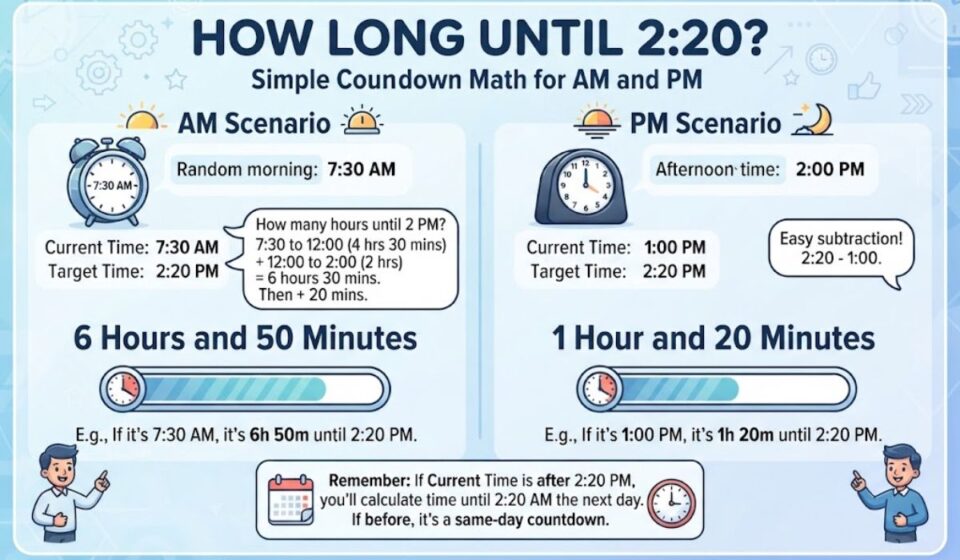
This is the trick worth remembering. Count to 2:00 first, then add 20 minutes.
It works because 2:20 sits exactly 20 minutes after the 2:00 mark. People also call it “twenty past two.”
- Find the time left until 2:00.
- Add 20 minutes.
- Check the total against your clock.
Worked Examples
| Current Time | Time to 2:00 | Add 20 Minutes | Final Answer |
| 10:45 AM | 3 hours 15 minutes | + 20 minutes | 3 hours 35 minutes |
| 12:35 PM | 1 hour 25 minutes | + 20 minutes | 1 hour 45 minutes |
| 9:10 AM | 4 hours 50 minutes | + 20 minutes | 5 hours 10 minutes |
Already past 2:00? Skip the anchor and subtract the minutes. At 2:12, the wait is 8 minutes.
The Minutes Only Method
If you like numbers, turn both times into minutes after midnight. 2:20 PM equals 860 minutes, from 14 × 60 plus 20.
At 10:45 AM, that’s 645 minutes. Subtract, and you get 215 minutes, or 3 hours 35 minutes. That matches the anchor result above.
For the night version, 2:20 AM equals 140 minutes (2 × 60 plus 20). This method works well in spreadsheets and apps, and it makes a good double check.
2:20 AM or 2:20 PM?
The two times sit exactly 12 hours apart. Choosing the wrong one flips your answer.
| Feature | 2:20 AM | 2:20 PM |
| Part of the day | Overnight | Afternoon |
| 24-hour format | 02:20 | 14:20 |
| Minutes after midnight | 140 | 860 |
| Typical situations | Night shifts, early flights, late travel | Classes, meetings, appointments |
| Countdown from noon | 14 hours 20 minutes | 2 hours 20 minutes |
When you share plans, write the full time, like “2:20 PM.” That one habit prevents most mix ups.
Crossing Noon or Midnight
Most long countdown errors happen when the wait crosses 12:00. The fix is simple: count in two chunks.
Say it’s 10:30 AM and you want 2:20 AM tomorrow. From 10:30 AM to 10:30 PM is 12 hours. Then add 3 hours 50 minutes. The total is 15 hours 50 minutes.
| Start | Target | Chunk 1 | Chunk 2 | Total |
| 10:30 AM | 2:20 AM | 12 hours to 10:30 PM | 3 hours 50 minutes | 15 hours 50 minutes |
| 6:00 PM | 2:20 AM | 6 hours to midnight | 2 hours 20 minutes | 8 hours 20 minutes |
| 9:00 PM | 2:20 PM | 3 hours to midnight | 14 hours 20 minutes | 17 hours 20 minutes |
What If 2:20 Already Passed?
Suppose it’s 2:30 PM. Today’s 2:20 PM is gone, so you’re counting to tomorrow.
Take the gap you missed and subtract it from 24 hours. Here, 10 minutes past gives you 23 hours 50 minutes.
| Current Time | Until Next 2:20 PM | Until Next 2:20 AM |
| 2:21 PM | 23 hours 59 minutes | 11 hours 59 minutes |
| 2:30 PM | 23 hours 50 minutes | 11 hours 50 minutes |
| 3:20 PM | 23 hours | 11 hours |
| 6:20 PM | 20 hours | 8 hours |
| 9:00 PM | 17 hours 20 minutes | 5 hours 20 minutes |
| 12:00 AM | 14 hours 20 minutes | 2 hours 20 minutes |
Leave By Planner
Often you don’t need the time until 2:20. You need the time until you must leave to arrive by 2:20.
| Travel Time | Leave By (for 2:20) |
| 10 minutes | 2:10 |
| 20 minutes | 2:00 |
| 30 minutes | 1:50 |
| 45 minutes | 1:35 |
| 60 minutes | 1:20 |
Add a small buffer for traffic, parking, or stairs. Five to ten minutes usually does the job.
When “2:20” Means a Length of Time
Sometimes 2:20 isn’t a spot on the clock. It’s 2 hours and 20 minutes, like the run time of a film or the length of a class block.
That equals 140 minutes. The math changes: you add or subtract a duration instead of counting to a moment.
| Question Type | Example | Answer |
| Countdown to a clock time | It’s 1:00 PM. How long until 2:20 PM? | 1 hour 20 minutes |
| Adding a duration | A 2:20 film starts at 6:30 PM. When does it end? | 8:50 PM |
| Adding across midnight | A 2:20 trip starts at 11:00 PM. When does it end? | 1:20 AM |
| Subtracting a duration | A 2:20 film ends at 7:05 PM. When did it start? | 4:45 PM |
Read the question twice before you calculate. A countdown and a duration need different steps.
Real Life Situations Where This Counts
The school day. A class change at 2:20 gives students a clear finish line. If it’s 1:50, you have 30 minutes left to wrap up your work.
Work calls. A 2:20 call comes faster than it feels. Count back from the start time to plan prep.
Appointments. Knowing you have 40 minutes left helps you decide whether to run one more errand.
Travel. A 2:20 departure needs a boarding buffer. The real countdown is to the moment you walk out the door.
Night shifts. A 2:20 AM handover means crossing midnight, so use the night chart above.
Reading the 24-Hour Clock
The 24-hour clock removes AM and PM. Add 12 to any afternoon or evening hour to convert it.
| 12-Hour Time | 24-Hour Time |
| 12:00 AM | 00:00 |
| 2:20 AM | 02:20 |
| 12:00 PM | 12:00 |
| 2:20 PM | 14:20 |
| 8:20 PM | 20:20 |
| 11:59 PM | 23:59 |
If your phone or transit app uses this format, subtraction gets easier. There’s no noon rollover to think about.
Time Zones and Daylight Saving
A 2:20 event in another city may land at a different hour for you. Convert the event time to your zone first. Then count from your own clock.
| Situation | Smart Move |
| Online class or webinar | Convert the start time before you plan |
| Cross border call | Confirm the time zone in writing |
| Travel between zones | Reset your device after arrival |
| Clock change weekend | Recheck, since an hour can vanish or repeat |
Let Your Device Do the Counting
Mental math is great. Tools are better when you’re busy.
| Tool | How To Use It | Best For |
| Voice assistant | Say “Set an alarm for 2:20 PM” | Hands full moments |
| Phone timer | Enter the minutes left | Short countdowns |
| Calendar alert | Set a reminder 15 minutes early | Meetings and appointments |
| Online countdown page | Pick 2:20 and choose AM or PM | Live seconds display |
| Smartwatch | Set a repeating alert | Daily routines |
An early alarm beats an exact one. Set it for 2:05 and you get 15 minutes to wrap up and move.
Common Mistakes and Do’s & Don’ts
Most errors come from assumptions, not from the math itself.
| Do | Don’t |
| Confirm AM or PM first | Assume 2:20 means the afternoon |
| Use the exact current minute | Round to the nearest hour |
| Count travel time separately | Treat every remaining minute as free |
| Split the count at noon or midnight | Subtract across 12:00 in one step |
| Set a warning alarm | Wait until the last minute to look |
Traps To Avoid
- Rounding. At 12:12 PM you have 2 hours 8 minutes, not “about two hours.”
- Borrowing slips. From 1:50 to 2:20 is 30 minutes, not 70.
- Wrong meridiem. Counting to 2:20 AM instead of PM shifts your answer by 12 hours.
- Time versus duration. Check whether the question wants a moment or a length.
Related Terms Worth Knowing
| Term | Meaning |
| Countdown | The time remaining until a set moment |
| Elapsed time | The time that has already passed |
| Meridiem | The AM or PM label on a 12-hour time |
| Twenty past two | A spoken way to say 2:20 |
| 14:20 | 2:20 PM written in 24-hour time |
| Time zone offset | The hour gap between two regions |
Frequently Asked Questions
How many minutes until 2:20 if it’s 2:00?
There are 20 minutes left, whether you mean AM or PM.
How long from noon to 2:20 PM?
2 hours 20 minutes, which equals 140 minutes.
Is 2:20 PM the same as 14:20?
Yes. Add 12 to the hour and keep the minutes.
How do I count down to 2:20 tomorrow?
Add the hours left today to the hours after midnight. From 8:00 PM, that’s 4 hours to midnight plus 14 hours 20 minutes, so 18 hours 20 minutes to tomorrow’s 2:20 PM.
Is 2:20 “twenty past two”?
Yes. It means 20 minutes after 2:00.
Conclusion: Your Quick Takeaway
To answer how long until 2:20, read the clock, pick AM or PM, and subtract. For a faster route, count to 2:00 and add 20 minutes.
Add a buffer when the moment matters. A 2:05 alarm turns a last minute rush into a calm start.Ready for your exact number? Check the clock, find that row in the charts above, and you’re done.